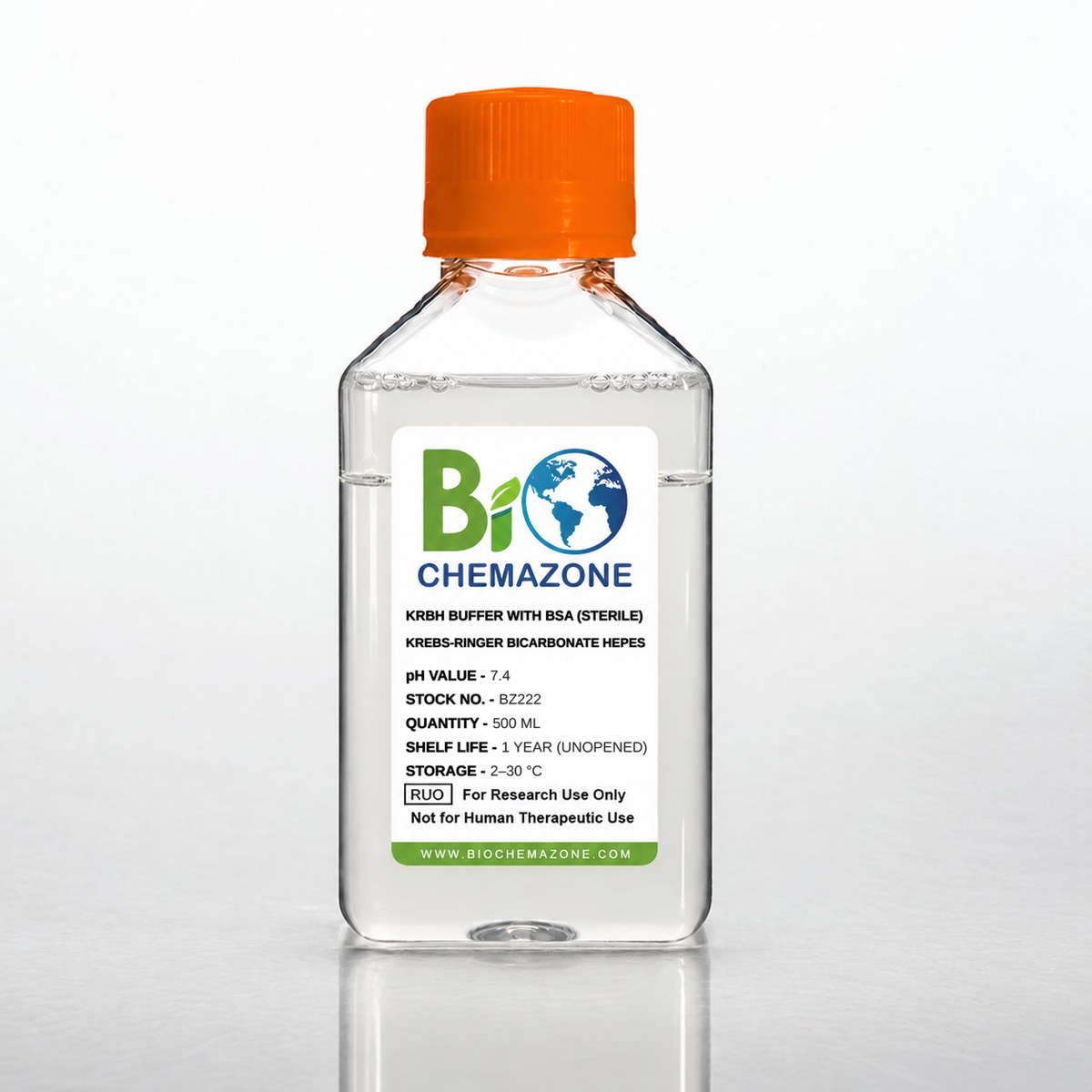
Description
Product overview
KRBH Buffer (BZ222) is a sterile Krebs-Ringer bicarbonate HEPES buffer with BSA and glucose, pH 7.4, for glucose-stimulated insulin secretion (GSIS), glucose-uptake and tissue incubation assays.
- Catalogue no.: BZ222
- Type: Krebs-Ringer bicarbonate HEPES buffer with BSA
- pH: 7.4
- Format: Sterile-filtered (0.2 µm)
- Pack sizes: 100 mL, 200 mL, 500 mL, 1 L
- Storage: 2–30 °C (2–8 °C preferred for long-term, contains BSA)
- Shelf life: 1 year (unopened bottle)
- On request: Version with preservatives; powder version
- Transportation: Room temperature
- Use: Laboratory research use only
Frequently asked questions
What is KRBH buffer used for?
Mainly for glucose-stimulated insulin secretion (GSIS) assays on islets and beta cells. It is also used for glucose-uptake, secretion and short metabolic incubation assays.
Why does KRBH contain HEPES and BSA?
HEPES keeps the pH near 7.4 even outside a CO2 incubator. BSA stops insulin and other secreted peptides sticking to tubes and plates.
Can I add my own glucose?
Yes. Add glucose to reach the basal or stimulatory level your protocol needs, or ask us for ready-made glucose levels.
Should I store it in the fridge?
Because it contains BSA, 2–8 °C is best for longer storage. Short-term storage at 2–30 °C is fine, and it ships at room temperature.
What is the shelf life of KRBH buffer?
Unopened bottles have a 1-year shelf life. Store tightly closed.
Krebs-Ringer Bicarbonate HEPES Buffer (KRBH)
Krebs-Ringer Bicarbonate HEPES Buffer (KRBH) composition and customer’s specified configurations can be delivered upon request. Glucose Level, BSA Content, Bicarbonate and HEPES Levels, Container Size, and Contents of the buffer are customizable.
Contact us for Customization: info@biochemazone.com
Transportation and storage: Transportation at room temperature, storage at 2–30 ℃
We provide shipping facilities worldwide.