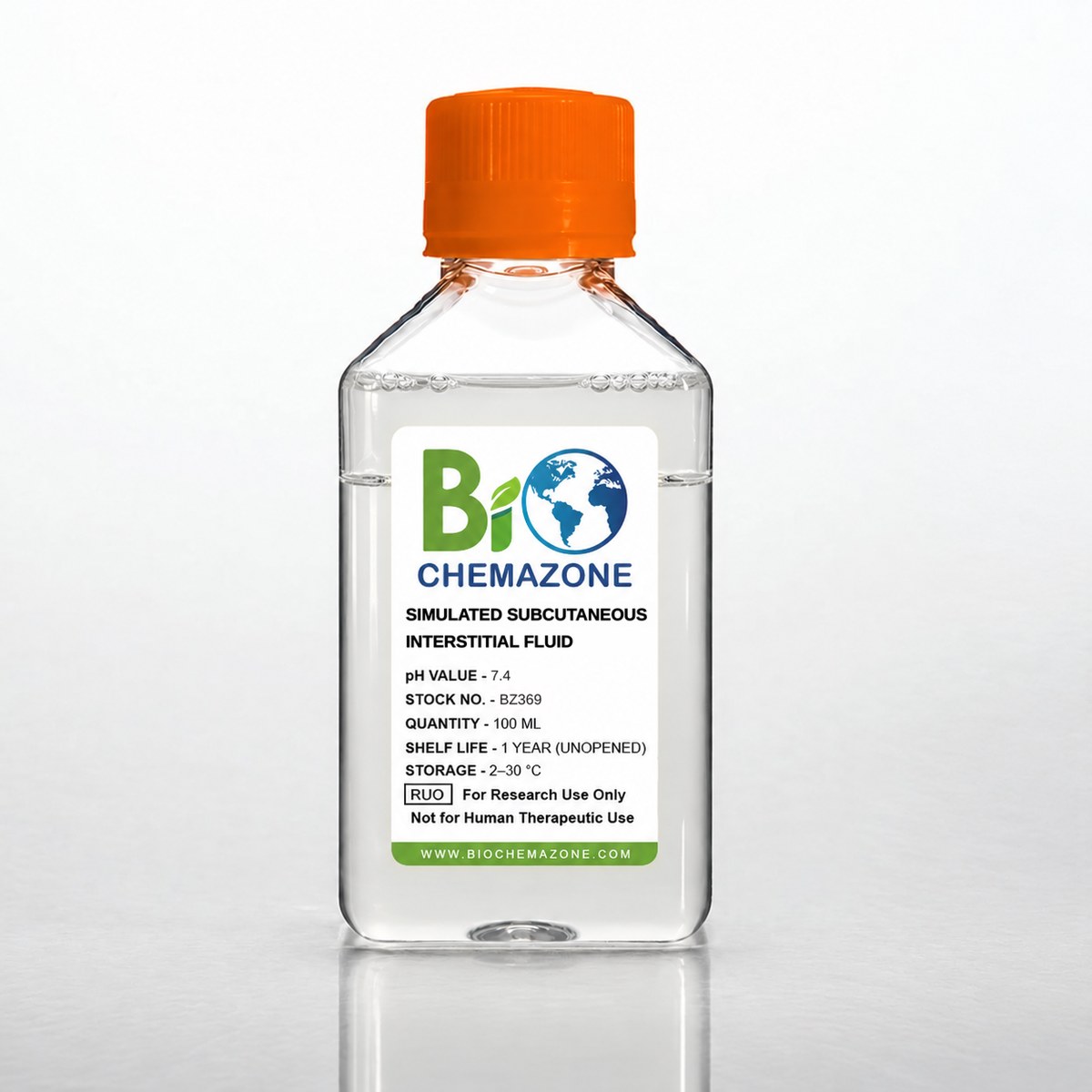
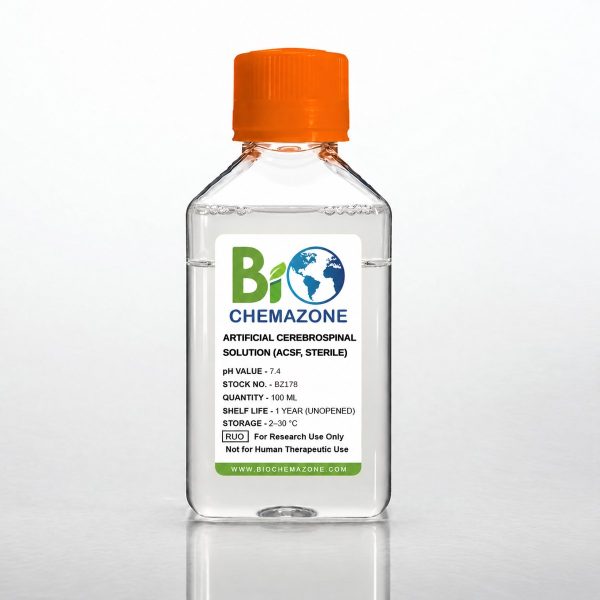
Simulated Subcutaneous Interstitial Fluid – Artificial Subcutaneous Tissue Fluid for In Vitro and Glucose-Monitoring Research, pH 7.4 BZ369
Product Code: BZ369
Manufacturer: Biochemazone
Available Pack Sizes: 100 mL, 200 mL, 500 mL, 1 L
Custom Bulk Quantities Available
Product Overview
Biochemazone Simulated Subcutaneous Interstitial Fluid BZ369, also called artificial subcutaneous interstitial fluid, is a sterile, ready-to-use solution that simulates the composition and pH of the interstitial fluid of the subcutaneous tissue. It is supplied at pH 7.4, and the pH can be customized to the project requirement.
Interstitial fluid is the thin layer of fluid that surrounds the body’s cells. It comes from substances that leak out of the blood capillaries, brings oxygen and nutrients to the cells and removes their waste products, and drains towards the lymph vessels. It contains glucose, salt, fatty acids and minerals such as calcium, magnesium and potassium, and it makes up almost 40% of the water in the body. The interstitial fluid just under the skin is the fluid that a continuous glucose monitor (CGM) reads: a small sensor is inserted under the skin, left in place for a number of days, and sends the glucose level of the surrounding interstitial fluid to a display every few minutes. BZ369 gives laboratories a subcutaneous interstitial fluid of constant composition for in vitro research.
It is supplied stabilized and has a 1-year shelf life unopened; a preservative-free version (6-month shelf life) and a dried Powder Version Kit are available on request. The formulation, minerals, organic content and pH can be customized. This simulated fluid is for scientific research and in vitro use only; it is not for clinical diagnosis or treatment. For glucose levels see Interstitial Fluid Glucose Panel BZ582; for ketone and lactate levels see Interstitial Fluid with Ketone and Lactate Levels BZ620; for the general interstitial fluid see Simulated Interstitial Fluid (BZ254).
Key Features & Benefits
✅ Simulates Subcutaneous Interstitial Fluid – The tissue fluid just under the skin
✅ pH 7.4 – Customizable to the project requirement
✅ Stabilized – Contains a preservative that stops microbial growth; 1-year shelf life unopened. Preservative-free version on request
✅ Sterile & Ready to Use – No weighing, mixing or pH adjustment before the test
✅ Reproducible & Standardized – Consistent batch-to-batch composition for routine QC and inter-laboratory comparison
✅ Made in Canada – Manufactured under ISO 9001 / GMP quality systems
Applications
📟 Glucose-Monitoring Research
• Background matrix for work on continuous glucose monitoring
• Studies of glucose in subcutaneous interstitial fluid
🔬 In Vitro Research
• Studies that need a subcutaneous interstitial fluid of constant composition
• Replacement for a fluid that is very difficult to collect
🧪 Laboratory Testing
• In vitro testing and diagnostic research
• Reproducible replacement for a fluid that cannot practically be collected
Typical Properties
- pH: 7.4 (customizable)
- Composition: Formulated to simulate the composition of the interstitial fluid of the subcutaneous tissue
- Format: Sterile, ready-to-use liquid, stabilized
Storage, Shelf Life & Transportation
- Storage Temperature: 2–30 °C, protected from light
- Transportation: At room temperature
- Shelf Life: 1 year (unopened)
- Preservative-Free Version: Available on request – shelf life 6 months unopened at 2–30 °C
- Powder Version Kit: Available on request – 2-year shelf life, easy to reconstitute and suitable for culture-related applications; recommended when a preservative is not required
- After Opening: Handle aseptically; close tightly after use and do not return unused material to the container
Customization Options
Customization available on request:
- pH adjustment to the project requirement
- Formulation, minerals and organic content
- Preservative-free (not-stabilized) version
- Powder Version Kit, custom pack sizes and bulk carboys (5 L, 10 L, 20 L)
Frequently Asked Questions
Why does a glucose monitor read interstitial fluid?
The sensor of a continuous glucose monitor sits just under the skin, in the interstitial fluid. Glucose there follows blood glucose with a delay of around 10 minutes, so the monitor applies a formula to estimate the blood value.
How long does the solution keep?
Unopened, the stabilized solution has a 1-year shelf life at 2–30 °C. A preservative-free version with a 6-month shelf life and a dried Powder Version Kit with a 2-year shelf life are available on request.
Ordering Information
BZ369 is available in standard laboratory sizes or OEM/bulk supply formats.
📄 MSDS, Technical Datasheet, and Certificate of Analysis (CoA) available upon request
📧 Email: info@biochemazone.com
🌐 Website: www.biochemazone.com
⚠️ For research, education, and in vitro testing only. Not for human or animal use.