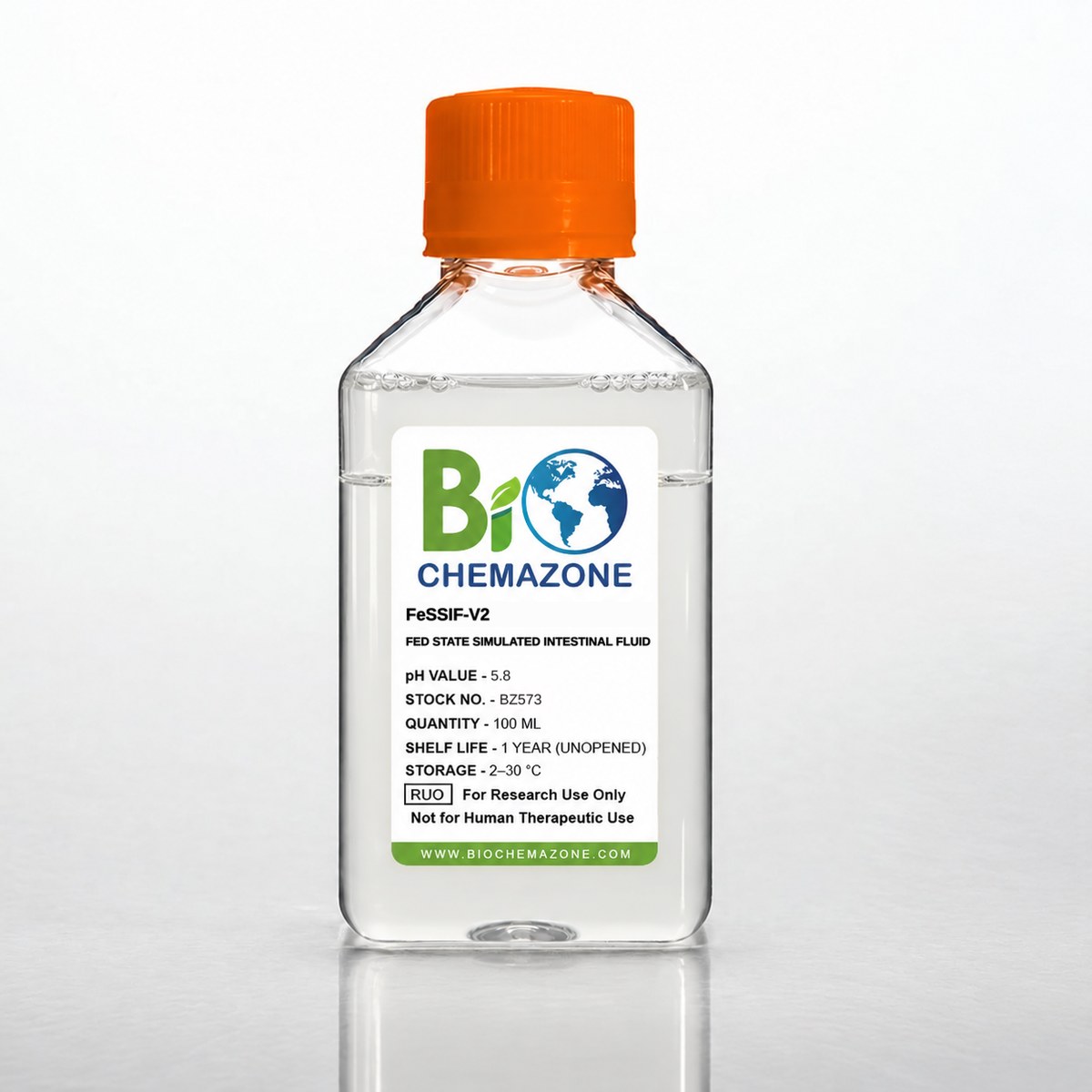
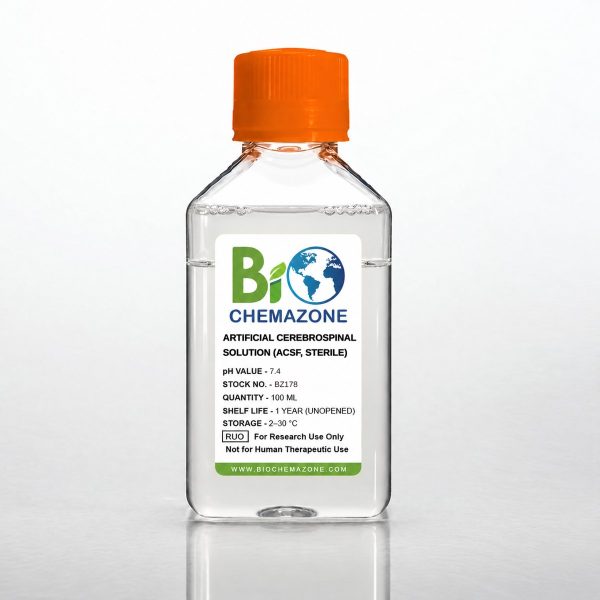
FeSSIF-V2 (Fed State Simulated Intestinal Fluid, Version 2) BZ573
Product Code: BZ573
Manufacturer: Biochemazone
Available Pack Sizes: 100 mL, 200 mL, 500 mL, 1 L
Custom Bulk Quantities Available
Product Overview
Biochemazone FeSSIF-V2 BZ573 is the updated fed-state simulated intestinal fluid described by Jantratid et al. (2008). In addition to bile salt and lecithin, Version 2 contains the fat-digestion products glyceryl monooleate and sodium oleate, so it reflects the intestine after a meal more closely than the original FeSSIF.
The medium contains sodium taurocholate (10 mM), lecithin (2 mM), glyceryl monooleate (5 mM) and sodium oleate (0.8 mM) in a maleate buffer at pH 5.8, with an osmolality of about 390 mOsm/kg. It is supplied ready to use, prepared with ISO 3696 compliant high-purity water under Biochemazone’s ISO 9001 / GMP quality system.
BZ573 is used to study food effects on dissolution and solubility, to compare fed and fasted behaviour alongside FaSSIF-V2, and to screen formulations of poorly soluble and lipophilic drugs.
Key Features & Benefits
✅ Version 2 Composition – Follows the updated fed-state medium published in 2008
✅ pH 5.8 – Maleate-buffered to the fed small-intestine pH
✅ Bile Salt + Lecithin – Sodium taurocholate 10 mM and lecithin 2 mM
✅ Lipolysis Products Included – Glyceryl monooleate 5 mM and sodium oleate 0.8 mM
✅ Physiological Osmolality – About 390 mOsm/kg
✅ Enzyme-Free – No pancreatin; suitable for dissolution and solubility work
✅ Ready-to-Use – No powder weighing or equilibration step
✅ Made in Canada – Manufactured under ISO 9001 / GMP quality systems
Applications
🧪 Food-Effect Dissolution Testing
• Fed-state dissolution profiles of oral dosage forms
• Fed versus fasted comparison with FaSSIF-V2
• Two-stage gastric-to-intestinal transfer experiments
💊 Solubility & Formulation Screening
• Solubility of lipophilic and poorly soluble drugs
• Lipid-based and self-emulsifying formulation studies
• Precipitation and supersaturation studies
🔬 Biopharmaceutics Research
• Input data for absorption modelling (PBPK)
• Food-effect risk assessment
• In vitro–in vivo correlation studies
Usage Areas
- Pharmaceutical formulation and pre-formulation laboratories
- Analytical development and dissolution laboratories
- Contract research and development organisations
- Generic-drug developers
- University pharmaceutics departments
Typical Properties
- Appearance: Opalescent to slightly turbid liquid
- pH: 5.8
- Bile Salt: Sodium taurocholate, 10 mM
- Lecithin: 2 mM
- Lipolysis Products: Glyceryl monooleate 5 mM; sodium oleate 0.8 mM
- Buffer: Maleate
- Osmolality: about 390 mOsm/kg
- Water Grade: ISO 3696 purified water
Storage & Stability
- Storage Temperature: 2–30 °C
- Shelf Life: 1 year for unopened bottles
- Shipping: Room temperature
- Best kept at 2–8 °C for prolonged storage and stability of the bile salt and lecithin components; storage at 2–30 °C is fine for short-term use
- Warm to 37 °C and mix gently before use; use opened medium within 48 hours
Customization Options
- pH and buffer adjustment
- Bile salt and lecithin level adjustment
- Addition of pancreatin on request
- Custom pack sizes and bulk / OEM supply
Ordering Information
BZ573 is available in standard laboratory sizes or OEM/bulk supply formats.
📄 MSDS, Technical Datasheet, and Certificate of Analysis (CoA) available upon request
📧 Email: info@biochemazone.com
🌐 Website: www.biochemazone.com
⚠️ For research, education, and in vitro testing only. Not for human or animal use.