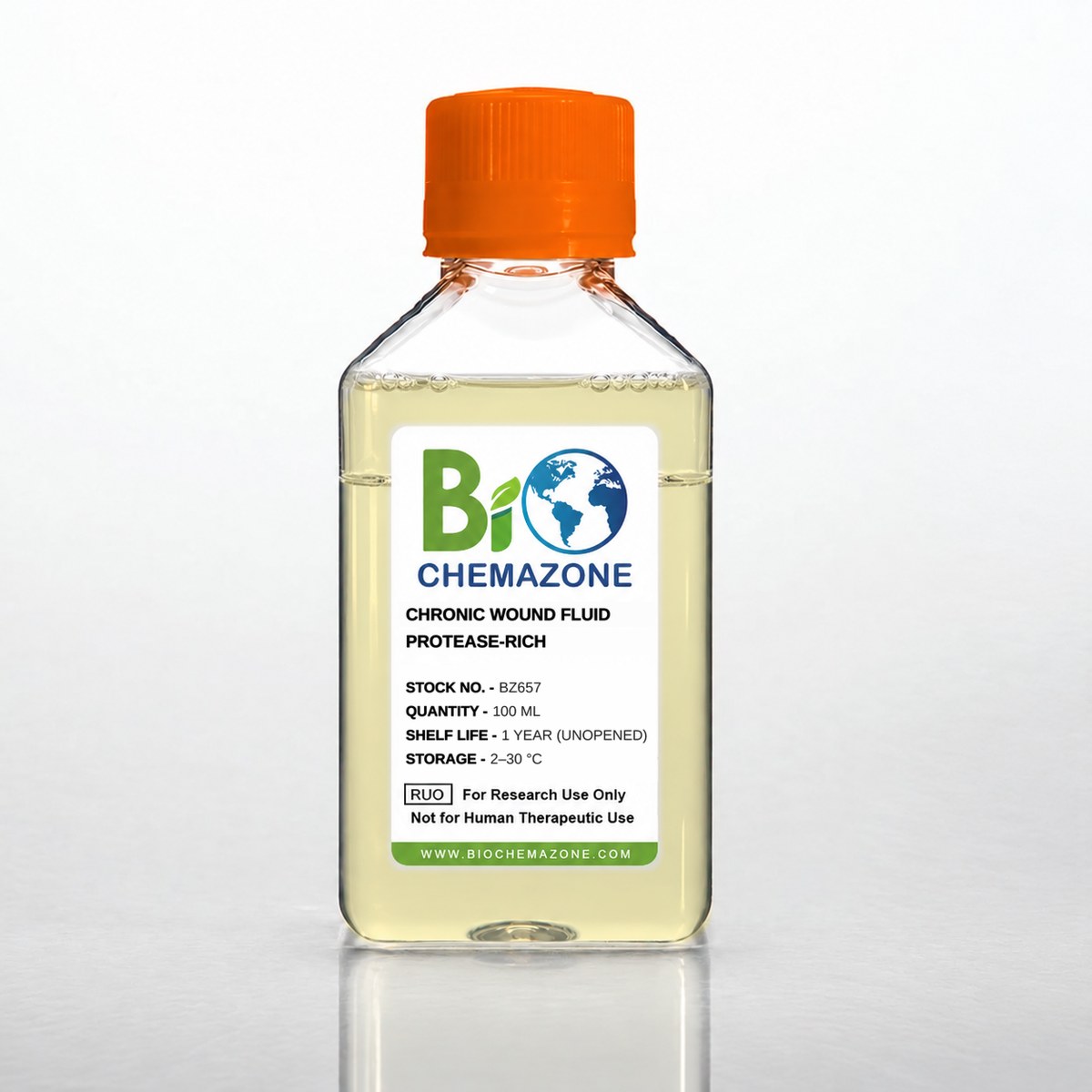
Chronic Wound Fluid (Protease-Rich) for Dressing Research BZ657
Product Code: BZ657
Manufacturer: Biochemazone
Available Pack Sizes: 50 mL, 100 mL, 200 mL, 500 mL
Custom Bulk Quantities Available
Product Overview
Biochemazone Chronic Wound Fluid (Protease-Rich) BZ657 is a simulated exudate for testing dressings and materials designed to bind, inhibit or reduce proteases in non-healing wounds. Fluid from chronic wounds such as venous leg ulcers and pressure ulcers typically carries far more protease activity than fluid from healing wounds, and this product lets that condition be reproduced in the laboratory.
Two types are offered. The protein base is a buffered salt solution with bovine serum albumin (animal-derived) and is used as the no-protease control. The protease-rich type adds proteases of the kinds found in chronic wound fluid, such as collagenase- and elastase-type enzymes; some enzymes are animal-derived, and the source and measured activity of each are stated on the certificate. Chronic wound fluid is often mildly alkaline, so the fluid is set to a pH of about 8.0 (range 7.5–8.5).
Measure protease activity in your own assay before and after exposure to the test dressing, using the control fluid alongside. Enzyme types and levels can be set to your protocol. Each batch is prepared with ISO 3696 compliant high-purity water under Biochemazone’s ISO 9001 / GMP quality system.
Key Features & Benefits
✅ Protease-Rich – Collagenase- and elastase-type activity
✅ Matched Control – Protein base with no added protease
✅ pH About 8.0 – Range 7.5–8.5, as in many chronic wounds
✅ Activity on Certificate – Enzyme source and activity per batch
✅ Adjustable Enzymes – Types and levels set to your method
✅ Room-Temperature Shipping – Ships at room temperature; best kept at 2–8 °C to keep enzyme activity stable
✅ ISO 3696 Grade Water – Prepared using high-purity laboratory water
✅ Made in Canada – Manufactured under ISO 9001 / GMP quality systems
Applications
🩹 Dressing Development
• Protease-modulating matrix testing
• Protease binding and sequestration studies
• Collagen and ORC dressing evaluation
🔬 Wound-Care Research
• Protease-inhibitor screening
• Growth-factor stability in hostile wound fluid
🧪 Materials Testing
• Degradation of biomaterials by proteases
• Comparison of chronic and acute wound conditions
Usage Areas
- Wound-care dressing manufacturers
- Biomaterials companies
- Contract research organisations
- University wound-healing groups
- Medical-device test laboratories
Typical Properties
- Appearance: Clear to slightly hazy, pale-yellow liquid
- pH: about 8.0 (range 7.5–8.5)
- Composition: Buffered electrolytes with bovine serum albumin; protease-rich type adds collagenase- and elastase-type enzymes
- Animal-Derived Components: Bovine serum albumin; some enzymes, as stated on the certificate
Storage & Stability
- Storage Temperature: 2–30 °C
- Shelf Life: 1 year for unopened bottles
- Shipping: Room temperature
- Best kept at 2–8 °C for prolonged storage and stability of the albumin and protease enzyme components; storage at 2–30 °C is fine for short-term use
- Mix gently before use
Customization Options
- MMP-rich version with recombinant enzymes
- Neutral (pH 7.4) or acidic versions
- Added bacteria-derived proteases
- Protease levels matched to published patient data
Ordering Information
BZ657 is available in standard laboratory sizes or OEM/bulk supply formats.
📄 MSDS, Technical Datasheet, and Certificate of Analysis (CoA) available upon request
📧 Email: info@biochemazone.com
🌐 Website: www.biochemazone.com
⚠️ For research and product testing only. Not for human or animal use. Contains animal-derived proteins.