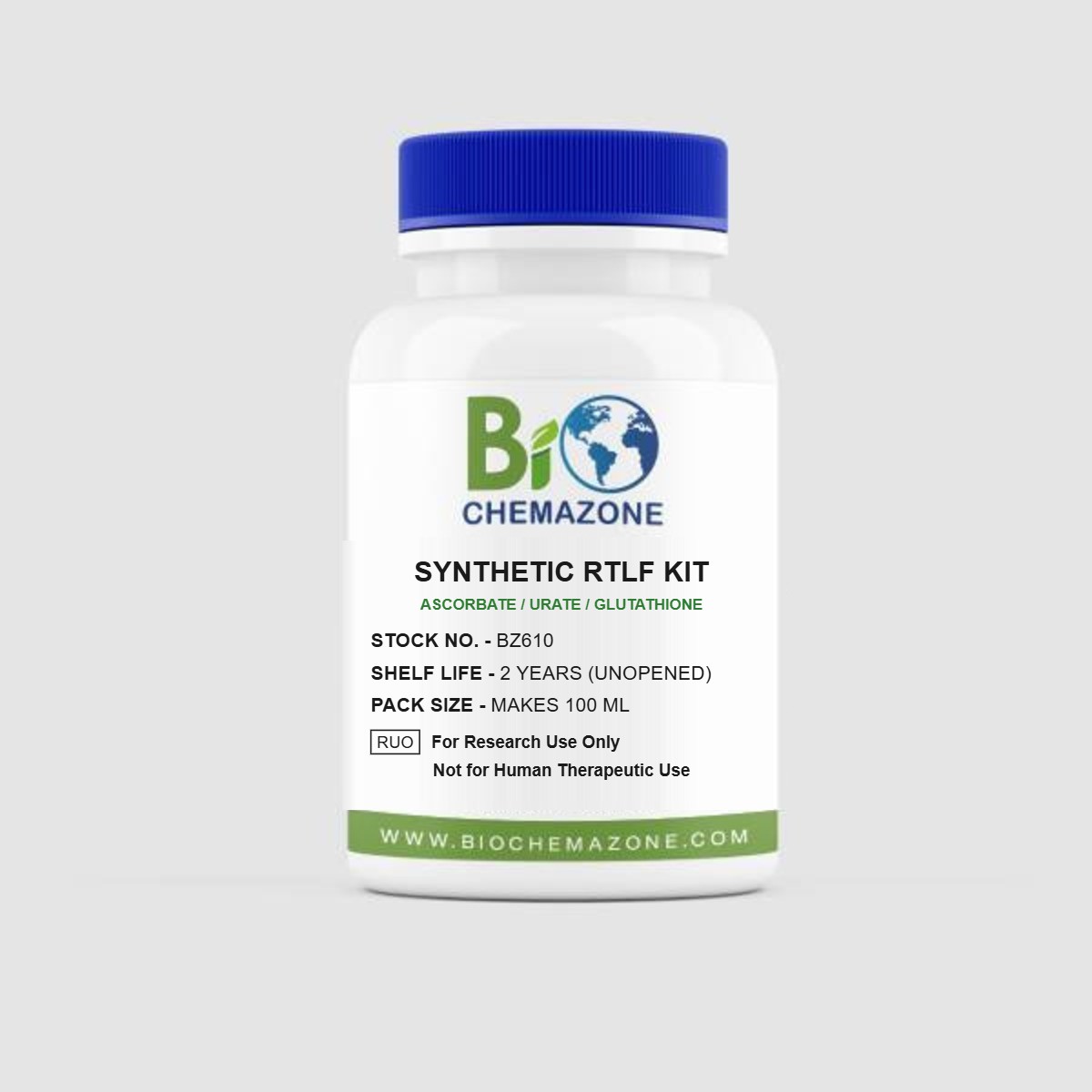
Synthetic Respiratory Tract Lining Fluid (RTLF) Kit – Antioxidant Model BZ610
Product Code: BZ610
Manufacturer: Biochemazone
Available Pack Sizes: Kits that make 50 mL, 100 mL or 500 mL
Custom Bulk Quantities Available
Product Overview
Biochemazone Synthetic Respiratory Tract Lining Fluid (RTLF) Kit BZ610 prepares a simple model of the antioxidant-rich fluid that coats the airways. The lung lining fluid contains the antioxidants ascorbate, urate and reduced glutathione, and inhaled particles that carry redox-active metals and organic compounds deplete them. Measuring that depletion in a synthetic RTLF is a widely used way of expressing the oxidative potential of air-pollution particles.
Each kit contains the three antioxidants and the buffered saline base as separate, pre-weighed components, because ascorbate and glutathione oxidise quickly in solution. Mixed as instructed, the kit gives a composite RTLF with ascorbate, urate and glutathione each at 200 µmol/L at a pH of about 7.0 (range 6.8–7.2), the concentrations commonly used in oxidative-potential assays.
The kit is prepared from high-purity reagents and ISO 3696 compliant high-purity water under Biochemazone’s ISO 9001 / GMP quality system and is supplied dry with a desiccant.
Key Features & Benefits
✅ Three Lung Antioxidants – Ascorbate, urate and reduced glutathione
✅ 200 µmol/L Each – The levels commonly used in oxidative-potential assays
✅ pH About 7.0 (Range 6.8–7.2) – Buffered saline base
✅ Supplied Dry – Antioxidants stay stable until you mix them
✅ Pre-Weighed Components – Consistent concentrations between runs
✅ Low Metal Background – Chelex-treated buffer to limit background oxidation
✅ Instructions Included – Preparation and incubation guide
✅ Made in Canada – Manufactured under ISO 9001 / GMP quality systems
Applications
🌫️ Air-Pollution Research
• Oxidative potential of PM2.5 and PM10 filter extracts
• Comparison of traffic, industrial and indoor particles
• Source-apportionment studies
🧪 Particle & Nanomaterial Toxicology
• Redox activity of engineered nanomaterials
• Screening of dusts and fibres
• Occupational-exposure studies
🔬 Method Development
• Antioxidant-depletion assay set-up
• Inter-laboratory comparison studies
Usage Areas
- Atmospheric and air-quality research groups
- Environmental-health and toxicology laboratories
- Nanomaterial safety researchers
- Occupational-health institutes
- Universities
How to Use
- Dissolve the buffer packet in the stated volume of ISO 3696 grade 1 water.
- Add the ascorbate, urate and glutathione vials immediately before use and mix gently.
- Check the pH (about 7.0) and use the RTLF the same day.
- Incubate with particle suspensions at 37 °C as your assay protocol describes.
Typical Properties
- Form: Pre-weighed buffer packet and three antioxidant vials
- Final pH: about 7.0 (range 6.8–7.2)
- Final concentrations: Ascorbate 200 µmol/L; urate 200 µmol/L; reduced glutathione 200 µmol/L
- Base: Buffered saline (Chelex-treated)
- Not included: Water
Storage & Stability
- Storage Temperature: 2–30 °C
- Shelf Life: 2 years unopened (dry powder)
- Shipping: Room temperature
- Best kept at 2–8 °C for prolonged storage and stability of the ascorbate and glutathione components; storage at 2–30 °C is fine for short-term use
- Prepared RTLF: use the same day; ascorbate and glutathione oxidise in solution
Customization Options
- Individual antioxidants in other concentrations
- Addition of proteins or lipids (lung-surfactant version)
- Bulk supply
Ordering Information
BZ610 is available in standard laboratory sizes or OEM/bulk supply formats.
📄 MSDS, Technical Datasheet, and Certificate of Analysis (CoA) available upon request
📧 Email: info@biochemazone.com
🌐 Website: www.biochemazone.com
⚠️ For research use only. Not for human or animal use.