Fed-State Gastric Media – Early, Middle and Late Stage BZ602
Product Code: BZ602
Manufacturer: Biochemazone
Available Pack Sizes: 100 mL, 200 mL, 500 mL, 1 L per stage, or sets of three
Custom Bulk Quantities Available
Product Overview
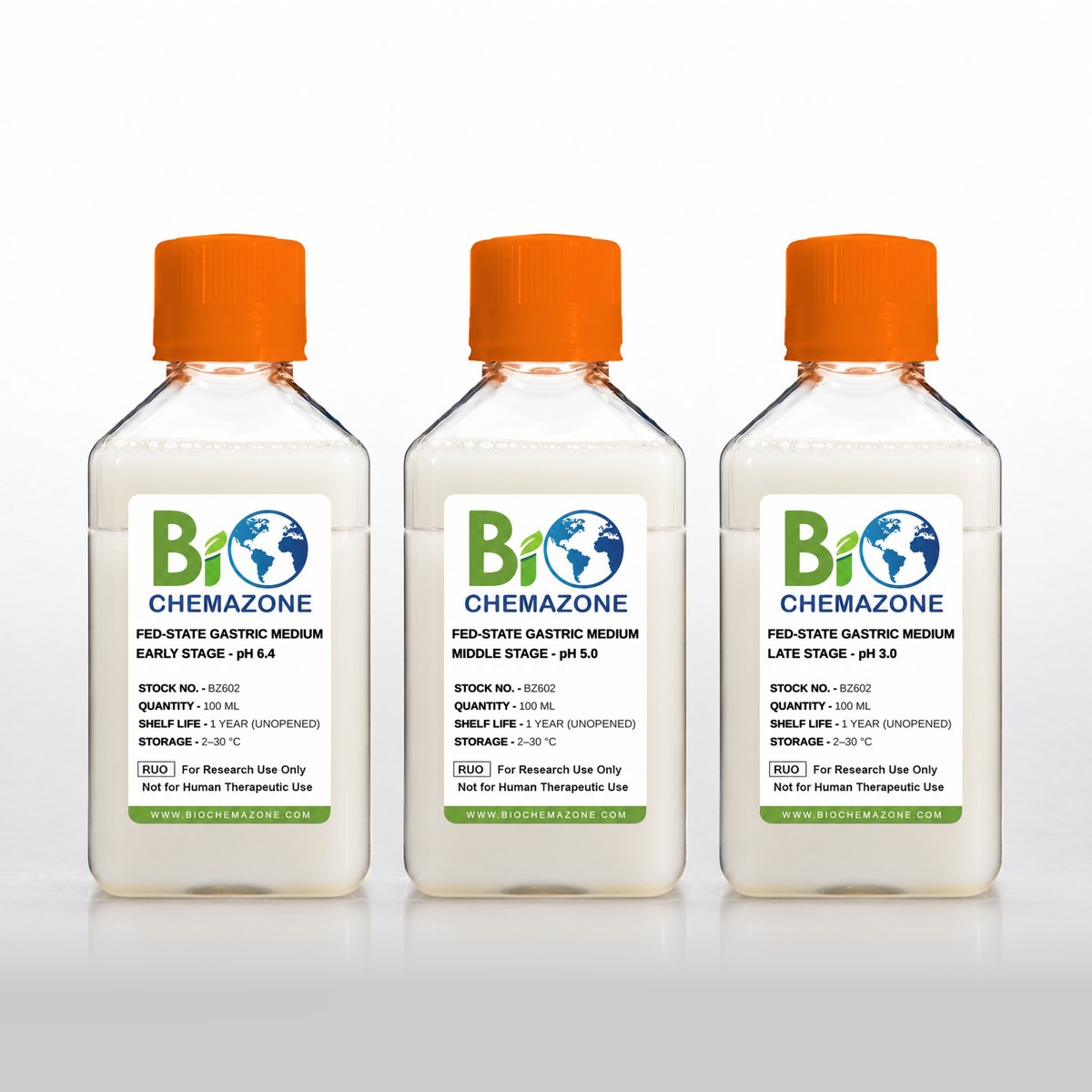
Biochemazone Fed-State Gastric Media BZ602 are three “snapshot” media that represent the stomach at different times after a meal, as described by Jantratid et al. (2008). After eating, the stomach contents change from mostly food at high pH to mostly gastric secretion at low pH, and a drug product can dissolve very differently at each stage.
Each medium is a mixture of milk and buffer, with the milk proportion falling and the acidity rising over time: early stage at pH 6.4, middle stage at pH 5.0 (equivalent to the widely used FeSSGF) and late stage at pH 3.0. The milk provides the fat, protein and carbohydrate of a meal, and the osmolality increases through the stages as it does in vivo.
Using all three stages shows whether a formulation’s release depends on gastric pH or food, which single-medium tests can miss. Each batch is prepared with ISO 3696 compliant high-purity water under Biochemazone’s ISO 9001 / GMP quality system. For the single middle-stage medium see our FeSSGF (BZ415).
Key Features & Benefits
✅ Three Postprandial Stages – Early, middle and late fed-state gastric media
✅ Stage pH Values – Early 6.4; middle 5.0; late 3.0
✅ Milk-Based Meal Component – Fat, protein and carbohydrate as in a meal
✅ Published Basis – Snapshot media of Jantratid et al. (2008)
✅ Single Stages or Sets – Buy one stage or all three
✅ Ready-to-Use – No mixing of milk and buffers
✅ ISO 3696 Grade Water – Prepared using high-purity laboratory water
✅ Made in Canada – Manufactured under ISO 9001 / GMP quality systems
Applications
💊 Food-Effect Dissolution
• Dissolution of oral dosage forms along the fed gastric time course
• pH-dependent release and precipitation studies
• Comparison of fasted and fed behaviour with FaSSGF
🧪 Formulation Development
• Food-effect risk assessment in early development
• Modified-release and enteric-coating robustness
• Lipid and nanoparticle formulation behaviour with food
🔬 Biopharmaceutics Research
• Input data for absorption modelling (PBPK)
• In vitro–in vivo correlation studies
Usage Areas
- Pharmaceutical formulation laboratories
- Dissolution and biopharmaceutics groups
- Contract research and development organisations
- Generic-drug developers
- University pharmaceutics departments
Typical Properties
- Appearance: Opaque, milky liquid
- pH: early 6.4; middle 5.0; late 3.0
- Composition: Milk and buffer (with sodium chloride), in stage-specific proportions
- Osmolality: Increases from early to late stage
- Water Grade: ISO 3696 purified water
Storage & Stability
- Storage Temperature: 2–30 °C
- Shelf Life: 1 year for unopened bottles
- Shipping: Room temperature
- Best kept at 2–8 °C for prolonged storage and stability of the milk (protein and fat) components; storage at 2–30 °C is fine for short-term use
- Warm to 37 °C and mix gently before use
Customization Options
- Addition of pepsin or gastric lipase
- Other pH or milk-to-buffer ratios
- Meal-type variations
- Custom pack sizes and bulk supply
Ordering Information
BZ602 is available in standard laboratory sizes or OEM/bulk supply formats.
📄 MSDS, Technical Datasheet, and Certificate of Analysis (CoA) available upon request
📧 Email: info@biochemazone.com
🌐 Website: www.biochemazone.com
⚠️ For research, education, and in vitro testing only. Not for human or animal use.