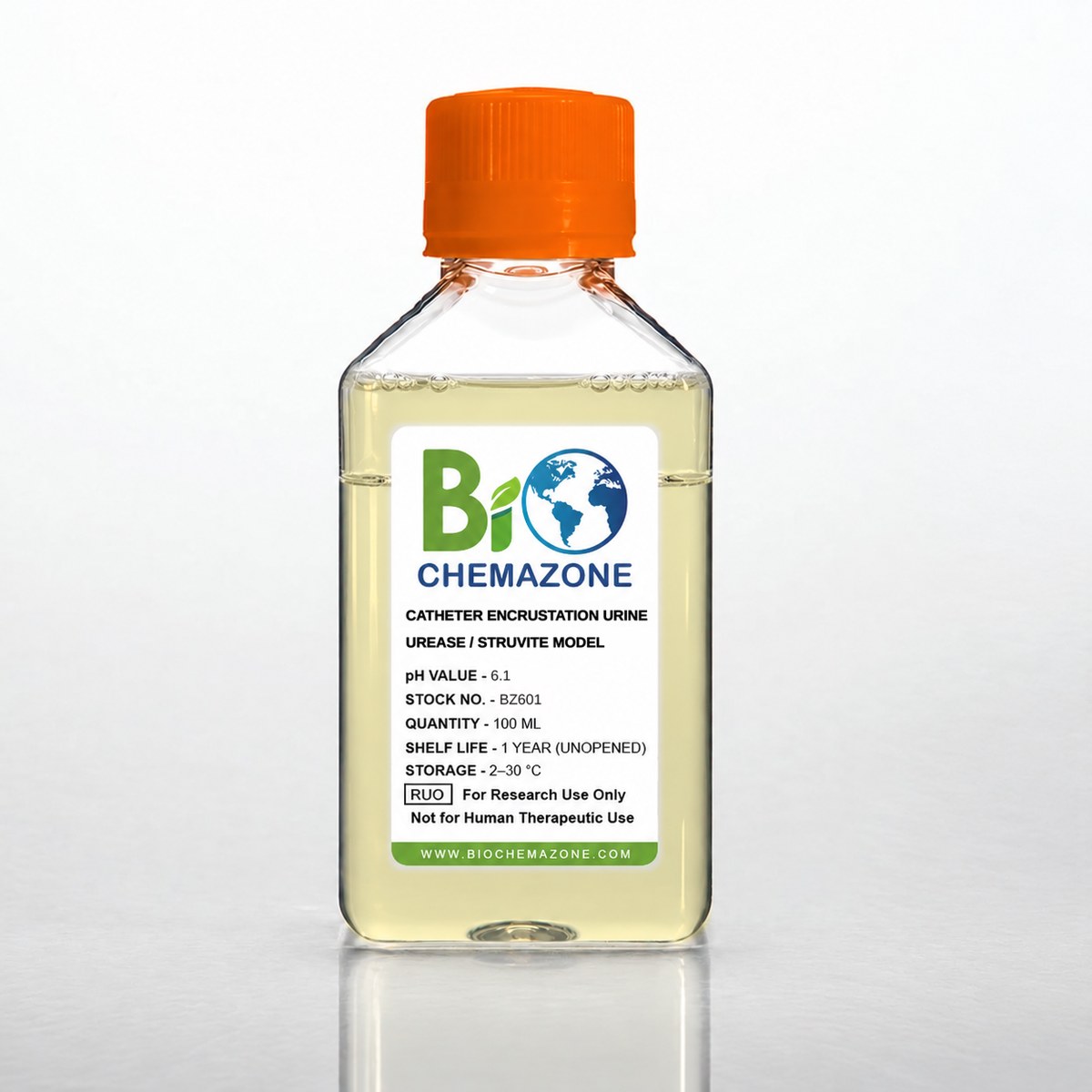
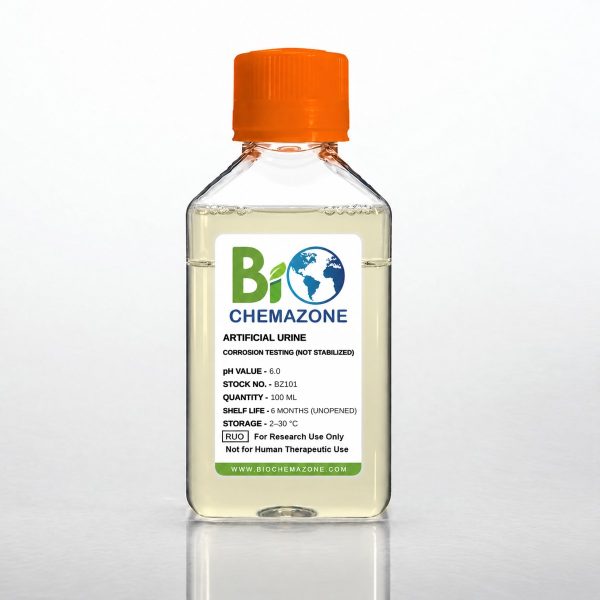
Catheter Encrustation Artificial Urine (Urease / Struvite Model) BZ601
Product Code: BZ601
Manufacturer: Biochemazone
Available Pack Sizes: 100 mL, 200 mL, 500 mL, 1 L (5 L and 20 L for flow models on request)
Custom Bulk Quantities Available
Product Overview
Biochemazone Catheter Encrustation Artificial Urine BZ601 is an artificial urine for laboratory models of catheter and stent encrustation. It is based on the artificial urine described by Griffith, Musher and Itin (1976), the recipe widely used in in vitro bladder models, and contains the calcium, magnesium, phosphate, citrate, oxalate and urea levels needed for mineral deposits to form.
The urine is supplied at a starting pH of about 6.1 (range 5.8–6.4). In an encrustation model, a urease-producing organism such as Proteus mirabilis (or added urease) breaks down the urea, the pH rises above 8, and struvite and calcium phosphate crystallise on the device, as they do on blocked catheters in patients. The medium is sterile-filtered so that only the chosen organism is present.
BZ601 lets device makers and researchers compare anti-encrustation coatings, materials and catheter designs under repeatable conditions. Each batch is prepared with ISO 3696 compliant high-purity water under Biochemazone’s ISO 9001 / GMP quality system.
Key Features & Benefits
✅ Griffith (1976) Recipe Basis – The artificial urine used in in vitro bladder models
✅ Encrustation-Ready Chemistry – Calcium, magnesium, phosphate and urea for struvite and apatite formation
✅ Starting pH About 6.1 – Rises above 8 when urease acts, as in infected urine
✅ Sterile-Filtered – Only your chosen organism grows
✅ Bulk for Flow Models – Larger volumes on request for continuous-flow bladder models
✅ No Human Urine – Consistent composition
✅ ISO 3696 Grade Water – Prepared using high-purity laboratory water
✅ Made in Canada – Manufactured under ISO 9001 / GMP quality systems
Applications
🩺 Urological Device Testing
• Catheter encrustation and blockage models
• Ureteral stent encrustation studies
• Anti-encrustation coating evaluation
🦠 Infection Research
• Proteus mirabilis and urease-producer studies
• Crystalline biofilm formation
• Urease-inhibitor testing
🔬 Materials & Stone Research
• Struvite and calcium phosphate crystallisation
• Surface-modification studies
Usage Areas
- Urinary catheter and stent manufacturers
- Medical-device test laboratories
- Urology and infection research groups
- Coating and biomaterials developers
- Universities
Typical Properties
- Appearance: Clear, pale yellow liquid
- Starting pH: about 6.1 (range 5.8–6.4)
- Composition: Urea, creatinine, calcium, magnesium, sodium, potassium and ammonium salts with phosphate, citrate, oxalate, sulfate and chloride, per the Griffith recipe
- Sterility: Sterile-filtered
- Water Grade: ISO 3696 purified water
Storage & Stability
- Storage Temperature: 2–30 °C
- Shelf Life: 1 year for unopened bottles
- Shipping: Room temperature
- Discard if a precipitate forms before use
Customization Options
- Supersaturation or calcium level adjustment
- Two-part version (calcium/magnesium and phosphate kept separate) for long runs
- Added urease
- Bulk supply for flow models
Ordering Information
BZ601 is available in standard laboratory sizes or OEM/bulk supply formats.
📄 MSDS, Technical Datasheet, and Certificate of Analysis (CoA) available upon request
📧 Email: info@biochemazone.com
🌐 Website: www.biochemazone.com
⚠️ For research and device testing only. Not for human or animal use.